Civic Climate Resilience Library
Translating $10M and nearly 10 years of research into a library of actionable tools for Texas communities and policymakers
UX Researcher, Designer, and Project Manager
Delivered research insights and design decisions with rationale, 50+ screen interactive prototype, site map, taxonomy and content type schemas, controlled vocabularies, estimate workbook with recorded walkthrough, work breakdown structure and resource allocation plan, institutional integration and governance plan, OKRs, 7-tab project management dashboard
-
Timeline: 18 months
-
Team: (Internal) 4 core leadership,15 principal investigators, 36+ community partners; (External) UT Center for Accessibility, UT Web Services, School of Architecture, Resilient Future Studio
-
Impact: Enabled multi-team alignment and budget decisions, saving $10K to 15K; On-track to launch in 2027


THE SITUATION
How do we translate nearly a decade of research into a lasting public resource?
Conflict
Planet Texas 2050 — a $10M, 10-year UT Austin climate resilience initiative — had no UX infrastructure and no unified platform. Research from 8 flagship projects, 15 PIs, and dozens of community partners lived across siloed sites with no shared discovery path.
Cost of the conflict
The initiative was approaching its end with a constrained remaining budget. Without a clear content model and technical requirements, leadership couldn't get a credible development estimate — and couldn't allocate remaining funds across the platform build and the suite of toolkits still being defined with another consultant.
THE STRUGGLE
Every single stakeholder essentially spoke a different "language" and had something different in mind.
Biggest challenge
9 stakeholder groups organized the same content in fundamentally different ways. The original brief — "build a website to showcase our research" — had no architecture behind it, no content model, and zero defined content entities. Every design decision had to be made from scratch, justified, and documented at a level non-UX staff could act on after handoff.
A failed attempt
Once our workstreams merged, the communications consultant and I had different ideas about scope, UX research integration and overall design approach, how to organize the platform, how to define a "toolkit" vs "tool" vs "resource", and the necessity for the distinction. We struggled to align on the site map initially.

MY SOLUTION
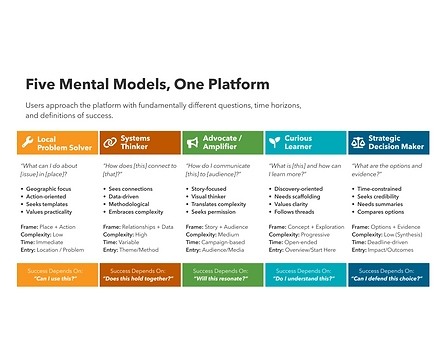
I identified 5 mental models among target users, informing a multi-point entry and filter information architecture strategy.
Breakthrough
I defined 10 content types supported by a card-sorting study, 12 controlled vocabulary sets, and a 6-section IA. I also delivered a 60+ page taxonomy reference document, 40+ clickable wireframes, and a comprehensive CMS/dev estimation workbook. The documentation enabled the dev team to produce a concrete build estimate. When that came in at $35,000–$40,000 (a bit over budget), I identified specific scope cuts and clarifications that brought it to $25,000–$28,000, unlocking the Director's ability to budget for both the platform build and the remaining toolkit work. The project is on track to launch in 2027.
WHAT I DID
Owned UX research, design, overall project management and stakeholder alignment across 6 entities
My Tasks
-
Problem definition and stakeholder alignment
-
Mixed-method research (website audit, 36+ interviews, surveys, synthesis workshops, card-sorting)
-
Information architecture and taxonomy design
-
Wireframing and prototyping (50+ screens)
-
Content types defined for custom build estimate
-
Strategic recommendations for long-term sustainability
Created a platform strategy that:
-
Serves 9 stakeholder groups (condensed to 5 archetypes) with conflicting mental models
-
Allows users to find actionable community resources
-
Can be maintained with minimal ongoing resources
-
Meets WCAG 2.1 AA accessibility standards

IMPACT
The infrastructure I built will enable the platform to be maintained and evolved long after the initiative sunsets.
The multi-entry architecture I designed means:
-
Researchers see their work organized by project/discipline
-
Policymakers see it organized by decision relevance
-
Communities see it organized by geography and lived experience
-
All of them are looking at the same content, just through different lenses that are relevant to them
Why this matters
This project required synthesizing input from stakeholders with competing priorities. The platform architecture gives each group what they need without fragmenting into separate siloed experiences. The templates, taxonomies, and governance rules will enable the platform to be maintained and extended by non-UX staff long after I'm gone, with limited resources.
REFLECTION
Managing collaboration in a large busy team and UX research operations on a small budget are big challenges. I think AI tools can assist if integrated thoughtfully.
Learnings
-
Get the team to focus on the problem definition first. "Build a website" leads to feature lists. "Serve 9 groups with conflicting mental models" leads to architectural thinking.
-
Jobs to Be Done reveals hidden conflicts. Researchers want attribution; communities want plain language. The IA had to do both.
-
Governance is a design deliverable. Templates and taxonomies are critical to ensure the system scales.
-
Lock the "definition of done" earlier. Toolkits vs. full ecosystem priorities can diverge midstream without explicit alignment on what "finished" means.
What I'd do differently
-
Set up research repository in week 1. I needed searchable evidence storage earlier.
-
Run RACI + collision mapping with other consultants earlier to make ownership explicit
-
Use AI to help with secondary research (comparative analysis).
-
Layered stakeholder outputs. Executive digest + working deck + deep archive on a regular cadence.


